
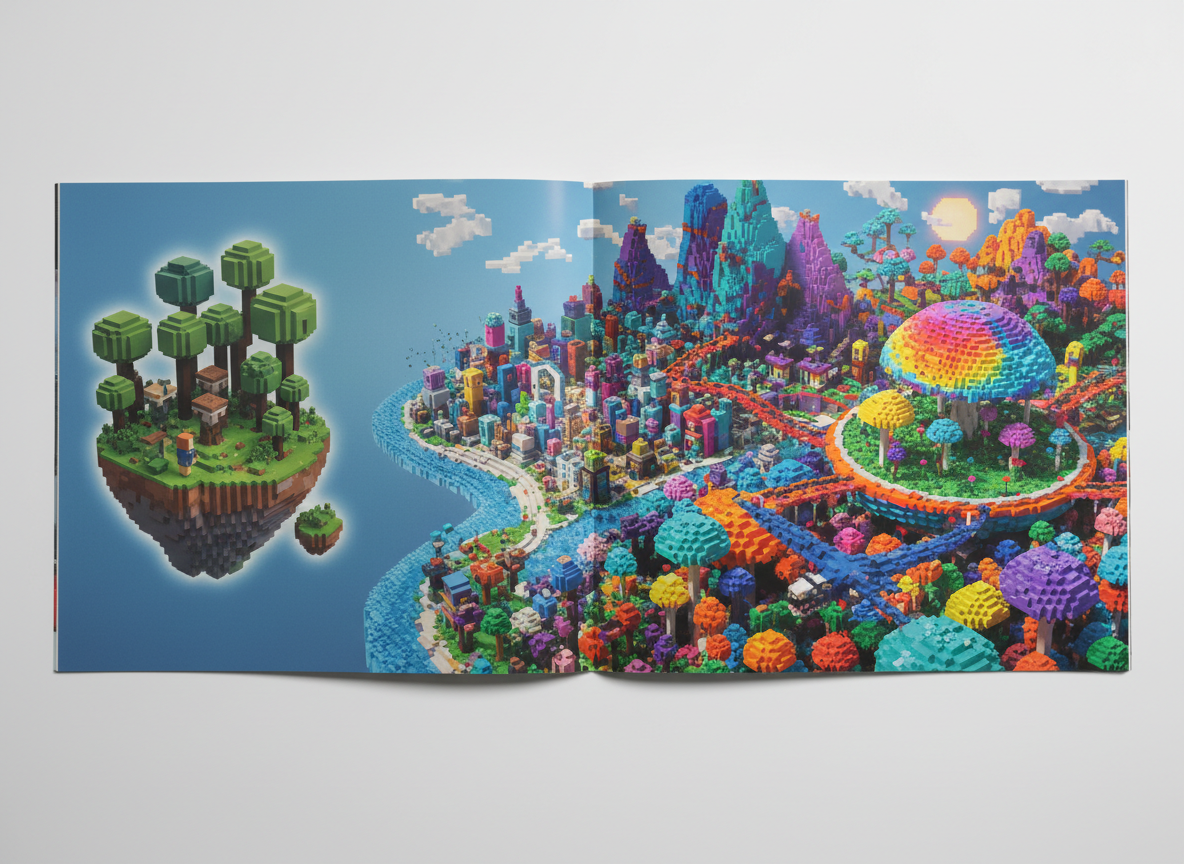
InfamousHub History · A detailed look at the people, technology and turning points behind a familiar name.

A simple idea with enormous possibilities
Minecraft began as a small independent game project associated with Markus “Notch” Persson. Its early identity was built around blocks, procedural worlds, gathering resources and giving players freedom to decide what to do.
2009: the early versions
Early Minecraft versions attracted attention online because the game looked simple but produced surprisingly deep player stories. Instead of guiding everyone through the same campaign, Minecraft created a world in which players could build, explore, survive and experiment.
The community becomes part of the game
Videos, forums, multiplayer servers and player-made creations helped Minecraft spread. The game became especially well suited to online video because almost every player could create a different story. A castle, automated farm, underground base or enormous pixel-art project could become content in its own right.
2011: the full release
Minecraft reached its full 1.0 release in November 2011. By then, the game had already developed a substantial community and an identity far beyond its original indie roots.
Microsoft enters the story
In 2014, Microsoft announced an agreement to acquire Mojang, the company behind Minecraft, for $2.5 billion. The acquisition brought Minecraft into one of the world’s largest technology and gaming companies while allowing the game to continue expanding across platforms.
Education, creativity and culture
Minecraft’s block-based world made it useful for more than traditional entertainment. Schools and educators have used versions of the game for collaborative projects, while communities use it to recreate buildings, landscapes and historical environments.
Why Minecraft lasted
The secret of Minecraft’s longevity is its flexibility. It can be a survival game, construction tool, social space, creative sandbox or educational environment depending on how it is used. Few games give players such a large role in deciding what the experience becomes.
Timeline
- 2009 — Early public versions appear.
- 2010 — Development and community accelerate.
- 2011 — Minecraft reaches full release.
- 2014 — Microsoft announces acquisition of Mojang.
- Later years — Cross-platform play, updates and new editions expand the audience.

Procedural worlds create endless stories
One reason Minecraft became so distinctive was the way its worlds could be generated and explored. Players did not simply move through a fixed sequence of levels. They could begin with a new world and immediately start making decisions about shelter, resources, exploration and construction.
Survival and creativity
Minecraft developed different styles of play. Survival mode gave players resource management, hostile creatures and environmental challenges. Creative mode removed many restrictions and turned the game into a construction environment. Multiplayer added another layer, allowing communities to create shared worlds and long-running projects.
YouTube and Minecraft grow together
Minecraft became unusually compatible with online video. Every session could generate a different story, and creators could explain builds, make challenges, play with friends or document enormous projects. This helped make Minecraft one of the defining games of the online-video generation.
Updates keep the world alive
Long-term development gave players reasons to return. New creatures, environments, blocks and mechanics expanded what could be built and explored without replacing the core idea of the game.
Microsoft and a wider ecosystem
The Microsoft acquisition brought Minecraft into a larger technology ecosystem. The game continued to appear across consoles, computers and mobile devices, strengthening its identity as a cross-platform phenomenon.
Why it became a cultural platform
Minecraft is unusual because players can use it for entertainment, storytelling, architecture, education and social interaction. Its visual simplicity also makes creations immediately recognizable. A small house and an enormous city can be built from the same basic vocabulary of blocks.
That flexibility helps explain why Minecraft reached audiences far beyond the traditional demographic of console gaming. It became a tool for making things as much as a game for consuming content.
Share this story
Explore more: InfamousHub · Games · Entertainment · Companies · History.
Kommentar verfassen